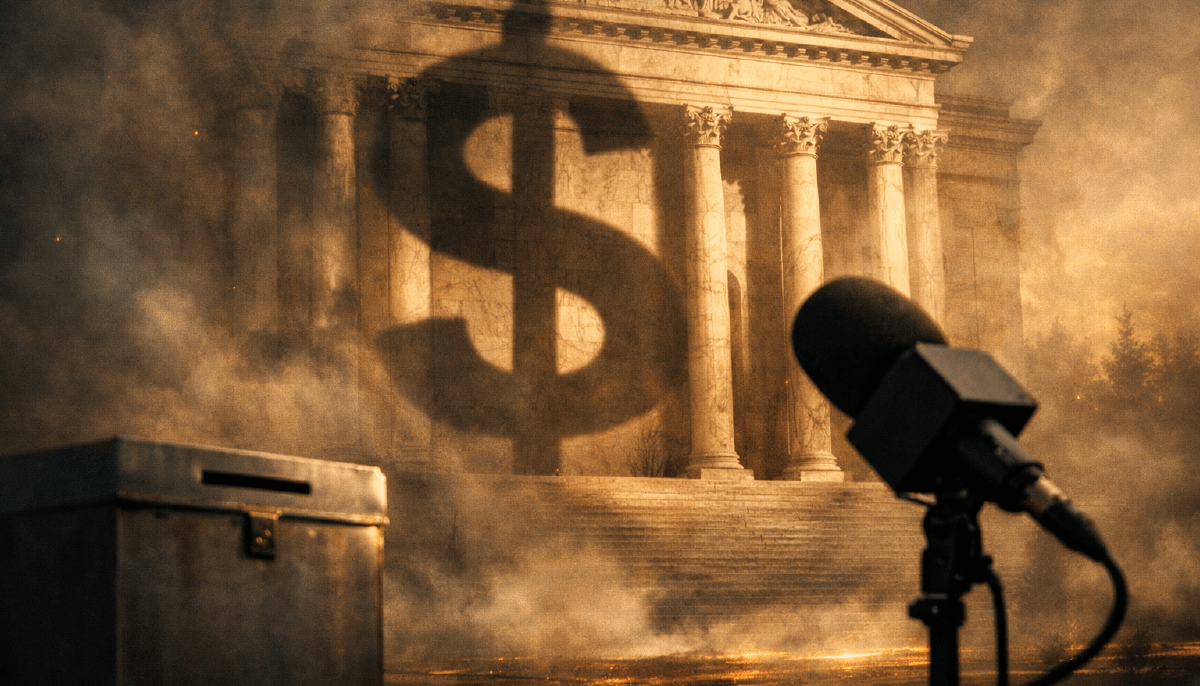
We Are Building an Oligarchy, On Purpose
January 2025. I’m reading about how 17 billionaires, worth collectively over a trillion dollars, got seated inside the Capitol Rotunda for Trump’s inauguration.
Not in the crowd outside.
Inside.
Front row.
And my first thought wasn’t “conspiracy.” It was “well, yeah.”
Because if you’ve been paying attention to campaign finance data, lobbying records, media ownership consolidation, and carbon emissions by wealth bracket, this isn’t shocking.
It’s the logical endpoint of legal choices we’ve been making for 15 years.
So let me break down what the numbers actually say. Not the vibes, not the outrage takes. The receipts.
TL;DR:
- Money doesn’t just influence elections anymore, it underwrites them - 140x increase in billionaire political spending since 2000, now 7.5% of ALL federal election money
- The megaphone monopoly - Media analyst: it’s now “unusual for major news media NOT to be owned by a billionaire”
- Carbon inequality is physics, not metaphor - 50 billionaires emit more in 90 minutes than an average person does in a lifetime
- When policy only responds to wealth - Analysis of 1,779 policy decisions shows elites get what they want, average citizens don’t
- Where to put your energy - Practical tiers that don’t require becoming a full-time activist
Money Doesn’t Just Influence Elections Anymore, It Underwrites Them 💰
Look, I get it. “Money in politics” sounds like the kind of complaint your uncle makes at Thanksgiving before someone changes the subject.
Here’s what changed.
After the 2010 Citizens United Supreme Court decision gutted campaign finance limits, political giving by the richest 100 Americans didn’t just increase.
It increased 140-fold between 2000 and 2024.
Not 140 percent. 140 TIMES.
Let me put that in perspective. In 2024, the top 100 U.S. billionaires accounted for about 7.5% of ALL federal election spending. In 2000, that number was 0.25%.
Roughly one in every 13 dollars spent in U.S. elections now comes from about 100 people.
Checkpoint: If one class can multiply its political spending by 140x while everyone else’s influence stays flat, do you really think the “marketplace of ideas” stays balanced?
And yes, I know the reflexive counter: “But rich people donate to both sides.”
True.
But that actually confirms the problem, it doesn’t solve it.
When BOTH parties need billionaire money to be viable, the donor class becomes a gatekeeper. Candidates who can’t attract mega-donors don’t survive primaries. Policy ideas that threaten billionaire interests don’t get serious airtime.
The direct pipeline is no longer subtle
In the 2024 cycle, over 80% of federal campaign contributions from the 100 wealthiest Americans went to Republican candidates or groups.
The most striking example: Elon Musk personally spent an estimated $294 million to help elect Donald Trump and other Republicans.
That’s not a donation. That’s underwriting a political movement.
You can debate whether any single donation “changed” an election outcome. Maybe it did, maybe it didn’t.
The issue is that the system has normalized this scale of influence as just another data point.
When one person can spend more on a single election than entire countries spend on their democratic processes, we’ve crossed from “money talks” into something structurally different.
Lobbying isn’t just persuasion, it’s regulatory capture
Beyond campaign cash, billionaires use the companies they control to maintain armies of lobbyists.
Here’s a concrete example that blew my mind: Amazon employed 115 lobbyists during the Trump administration.
Want to guess how many of those 115 focused on environmental issues?
One.
One out of 115.
That same year (2019), Jeff Bezos announced Amazon’s high-profile “Climate Pledge.” Big press event, lots of green marketing.
Meanwhile, Amazon’s PAC was donating to Senate Republicans known for blocking climate legislation, and 114 out of 115 lobbyists were working on taxes, antitrust, labor, and other business concerns.
This pattern shows up everywhere. Public commitments to sustainability, diversity, whatever sounds good in the annual report. Private lobbying focused entirely on protecting profit margins.
That’s not hypocrisy. That’s strategy.
And it’s not limited to one company. A Washington Post analysis found that 44 of the 902 U.S. billionaires (or their spouses) have held public office or top advisory posts in the past decade.
When you can’t lobby the government, just become the government.
The Megaphone Monopoly 📺
Democracy assumes something that isn’t automatically true: that citizens can access a shared baseline reality.
Here’s a quote from Claire Enders, a leading media analyst, that should make you uncomfortable:
“It’s unusual for major news media NOT to be owned by a billionaire.”
Read that twice.
Not “some outlets are billionaire-owned.”
It’s UNUSUAL for them NOT to be.
Enders continued: “It’s another sign that the super-wealthy wish to control assets that give them an extra level of power. Whatever they may say, that’s the reason why they buy them.”
Media ownership offers a megaphone. It shapes what gets covered, what gets ignored, what becomes “common sense” in public discourse.
The scale is unprecedented
Let’s run through some examples:
Elon Musk bought Twitter (now X) for $44 billion in 2022. He claimed it was about “free speech.” Researchers say what actually happened was he fired content moderation teams, changed rules to amplify misinformation, and turned the platform into what one analysis called a “cesspool of misinformation.”
Musk has 150+ million followers. His tweets regularly blur fact and opinion on immigration, election fraud claims, whatever aligns with his ideological preferences. And he controls the algorithm that decides what 500+ million users see.
Jeff Bezos bought The Washington Post in 2013 for $250 million. To his credit, the paper has continued quality investigative journalism under his ownership.
But the question stands: Will a paper owned by the world’s second-richest man aggressively report on wealth inequality or antitrust issues involving Amazon?
Bezos says he doesn’t interfere in editorial decisions. Maybe that’s true. But the structural conflict exists whether he pulls the levers or not.
Larry Ellison (Oracle co-founder, net worth over $200 billion) recently orchestrated an $8 billion merger giving him control of Paramount Global, including CBS News. He also acquired a major stake in TikTok’s U.S. operations.
One family now controls broadcast TV, cable news, Hollywood studios, and one of the world’s largest social media platforms.
Ellison is a well-known Republican donor and Trump confidant. His son David presents as more centrist. The combination of old and new media they control reaches more people than Rupert Murdoch’s empire ever did.
And Ellison’s fortune is reportedly more than 30 times larger than Murdoch’s.
Narrative shaping isn’t subtle
The concern isn’t just that billionaires own media as a business investment.
The concern is they can shape narratives to protect their interests or ideology.
A media outlet controlled by a fossil-fuel billionaire might platform climate skeptics. A tech billionaire’s media arm might editorialize against antitrust enforcement.
Even subtle biases compound. Which experts get op-eds. What tone is taken toward labor unions or tax policy. What gets front-page treatment versus buried on page 37.
There’s documented history here. Between 2002 and 2010, conservative billionaires quietly funneled around $120 million to more than 100 anti-climate science groups, using pass-through entities to stay anonymous.
This “dark money” turned climate change from scientific consensus into partisan wedge issue. It funded think tanks, media campaigns, and advocacy groups that sowed doubt and delayed policy action for over a decade.
The result: a conservative backlash that wrecked any chance of Congress taking meaningful climate action during the Obama years.
When you can buy the megaphone, you can rewrite reality.
Checkpoint: If billionaires can shape what people believe is happening, how much voting “freedom” is left in practice?
Carbon Inequality Is Physics, Not Metaphor 🔥
This is where the conversation moves from “that’s unfair” to “that’s physically unsustainable.”
Because we’re not just talking about political influence. We’re talking about carbon budgets and atmospheric chemistry.
Here’s the stark math: The world’s richest 0.1% (roughly the billionaire class) will use up their entire “fair share” of the planet’s carbon budget for 2026 in just 3 days.
The richest 1% in about 10 days.
Meanwhile, the poorest 50% of humanity takes an entire year to use the same amount.
The numbers are almost impossible to process
A first-of-its-kind study tracked 50 of the world’s wealthiest billionaires. In a single year:
- They took an average of 184 private jet flights, spending 425 hours in the air
- Those flights alone produced as much CO₂ as an average person would over 300 years
- Their yachts emitted carbon equal to what an average person would over 860 years
Jeff Bezos’s two private jets logged nearly 25 days of flight time in one year, emitting as much carbon as 207 years of an average Amazon employee’s emissions.
But here’s the thing people miss.
The private jets and yachts are just the symbol. The real weapon is the portfolio.
An Oxfam analysis found that billionaires’ investment portfolios cause 340 times more emissions than their private jets and yachts combined.
About 40% of billionaire investments are in polluting sectors like oil, gas, coal, cement, and petrochemicals. That makes their financial assets about twice as emissions-heavy as a standard stock portfolio.
Another study zeroed in on 12 prominent billionaires (Musk, Bezos, Gates, Larry Page, Bernard Arnault, others). Combined annual footprint:
17 million tons of CO₂ per year through direct lifestyles and investments.
That’s more than the yearly emissions of 2.1 million typical homes. Or about 4-5 coal-fired power plants running for a year.
So when someone tells you “we all just need to do our part,” sure.
But let’s be real about the scale here.
The climate veto
Here’s the trapped-between-two-realities framing:
On one side: You’re told to use reusable bags, recycle, bike to work, buy carbon offsets.
On the other side: A tiny class can block, dilute, or derail climate policy when it threatens their profit model.
And they do.
The most infamous example: the Koch brothers (petrochemical billionaires) poured money into lobbying and advocacy to cast doubt on climate science and block legislation.
The Guardian uncovered that between 2002-2010, conservative billionaires funneled $120 million to more than 100 anti-climate groups, using anonymous pass-through entities.
This dark money vastly exceeded even direct oil company contributions. It funded aggressive climate denial campaigns and killed policies like cap-and-trade.
The legacy is still felt. U.S. federal climate policy lagged for decades in large part due to this coordinated misinformation effort.
Even billionaires not overtly in the oil business contribute through political donations. Remember Amazon’s 115 lobbyists with only one working on climate?
In 2020, Amazon’s PAC overwhelmingly gave to Senators who had obstructed climate action, despite Amazon’s public sustainability commitments.
The pattern repeats: green marketing in the annual report, lobbying against aggressive climate policy behind closed doors.
Investment patterns lock in ecological harm
Beyond direct emissions, billionaires’ investment decisions lock in environmental damage for decades.
Bernard Arnault’s LVMH (luxury fashion empire) has substantial environmental impact from textile production, energy use, water consumption, global retail operations, and waste.
Arnault once publicly called teenage activist Greta Thunberg’s climate warnings “demoralizing” for business. LVMH has since launched sustainability initiatives, but the company’s primary obligation is shareholder returns, and growth inherently drives resource consumption upward.
Elon Musk gets credit for Tesla accelerating EV adoption (which does help reduce transport emissions long-term). But his other ventures tell a different story.
SpaceX rocket launches burn massive fuel and release pollutants at high altitudes. As space tourism and satellite deployments scale, this becomes a non-trivial emissions source.
His Boring Company focuses on car tunnels rather than improving mass transit. Even when appearing as a climate ally, the approach sidelines systemic changes (better public transportation, reduced consumption) in favor of high-tech, high-profit paths that still consume enormous resources.
One analysis noted: If everyone’s carbon footprint matched the wealthiest 1%, humanity would blow through the remaining carbon budget for 1.5°C warming in just 5 months.
If everyone emitted like the average billionaire’s yacht and jet usage? Two days.
It underscores the physical impossibility of these lifestyles in a sustainable world.
When Policy Only Responds to Wealth 🧠
This is the part where “economic inequality” becomes “democratic erosion.”
Political science research shows a brutal pattern: When affluent and average citizens disagree on policy, policymakers overwhelmingly side with the affluent.
A landmark analysis of 1,779 U.S. policy issues (the Gilens & Page study) concluded:
“Economic elites and organized business groups have substantial independent impacts on U.S. government policy, while average citizens have little or no independent influence.”
If a policy change lacked support from the wealthy, its chances of being adopted were near zero. Even if most everyday voters wanted it.
Let that sink in.
The study found that average citizens have “little or no independent influence” on policy outcomes.
If you’re wondering why people are checking out of civic life, this is a decent place to start.
The feedback loop is vicious
Extreme inequality doesn’t just tilt policy. It fractures social cohesion.
The wealthy live behind walls and fly above traffic. Everyone else lives inside the consequences.
Separate worlds form.
When billionaires have little interaction with common public spaces, their lived experience becomes fundamentally alien to most people’s reality. They don’t deal with failing public schools, crumbling infrastructure, or unaffordable healthcare.
So why would lawmakers backed by billionaires prioritize those issues?
A 2025 study published in PNAS found that economic inequality is one of the strongest predictors of democratic erosion worldwide.
In countries with soaring wealth gaps, citizens experience grievance, frustration, and skepticism toward “elite” institutions. This creates fertile ground for authoritarian populists who channel those grievances.
The study noted that in the 21st century, threats to democracy often come via elected leaders (not military coups) who exploit public anger at elites while ironically serving other elite interests.
High inequality fuels polarization. And the more polarized the public becomes, the more willing a segment of the public will be to turn a blind eye to leaders attacking the press, courts, and other democratic institutions.
This dynamic played out in the U.S., where soaring inequality since the 1980s preceded deep polarization and the election of a president who openly challenged democratic norms.
The dynastic wealth problem
As billionaires pass fortunes to heirs, we risk an aristocratic structure where a small number of families hold lasting dominance.
Many of America’s richest are already second or third generation: Waltons (Walmart), Mars family (candy), various oil and real estate dynasties.
A class of people can wield power without accountability. They were never elected. They cannot be voted out. Yet by virtue of inherited wealth, they fund campaigns, lobby, and own companies that shape everyone’s lives.
Some historians suggest we’re in a “Second Gilded Age” now, similar to the 1890s when tycoons like Carnegie, Rockefeller, and Vanderbilt commanded industrial empires and politics until progressive reforms reined them in.
Bernie Sanders drew large crowds on a “Fighting Oligarchy” tour in 2024-25, tapping into sentiment that democracy must be reclaimed from billionaires.
“We’re living in a nation where ordinary people are struggling while people like Musk and Larry Ellison are making billions every day,” Sanders remarked.
Notably, this concern isn’t just progressive. Polls show 75% of Democrats AND 60% of independents view billionaire election spending as bad for democracy.
Checkpoint: What does “representation” mean when the people writing checks never have to live under the same rules?
Where to Put Your Energy ⚙️
I’m not ending this with a “10-step plan to save democracy.”
But there are levels to this.
Tier 1: Stop treating the problem like personal morality
The system wants to reframe billionaire power as either:
- Individual virtue/vice (“some billionaires are good people!”)
- Personal jealousy (“you’re just envious”)
- Conspiracy thinking (“tinfoil hat territory”)
It’s none of those. It’s arithmetic.
Notice how often debates get redirected into culture-war noise instead of power analysis. That’s not an accident.
Learn the mechanics: campaign finance rules, ownership structures, lobbying disclosure, procurement, tax policy.
This isn’t doomerism. It’s basic civic literacy.
Tier 2: Rebuild reality anchors
- Support local journalism where you can, even if it’s boring and imperfect. Local reporters are often the only people tracking city council decisions, school board votes, county budgets.
- Treat platform-level virality as a hostile environment for truth. Algorithms optimize for engagement (outrage, shock, tribal signaling), not accuracy.
- Be suspicious of “neutral” billionaire media projects. Neutrality is not the same as independence. Follow the ownership, not the branding.
Tier 3: Push for structural constraints
If concentrated wealth can buy the rules, then the rules need to constrain concentration.
That includes:
- Stronger campaign finance constraints and transparency - Overturn Citizens United, set donation limits, require dark money disclosure
- Antitrust enforcement - Break up media monopolies, platform monopolies, and industries with oligopolistic control
- Climate policy that targets high-emissions luxury behavior AND portfolio emissions - Tax private jets, yachts, mega-mansions. Force transparency on investment carbon footprints. Make polluting expensive for those who can afford alternatives.
- Lobbying rules that don’t treat regulatory capture as legitimate business strategy - Revolving door restrictions, disclosure requirements, limits on corporate lobbying budgets
None of this is magic.
But pretending the market will politely self-correct while a few dozen people fund elections and own the megaphone is fucking magical thinking.
Bottom Line
We’re not “drifting” into oligarchy. We’re building the infrastructure for it, one legal choice at a time.
The 2010 Citizens United decision wasn’t an accident. The gutting of antitrust enforcement wasn’t an accident. The normalization of billionaire media ownership wasn’t an accident.
These were deliberate policy choices, often lobbied for by the people who benefit most.
If this feels overwhelming, zoom out.
The goal isn’t purity. The goal is leverage.
Questions worth sitting with:
- What would politics look like if campaigns weren’t dependent on the ultra-wealthy?
- What climate policies become possible when the biggest polluters can’t buy a veto?
- What happens to a society when it loses the idea that rules apply equally?
The most honest assessment? We’re at a choice point.
Either we rebuild democratic constraints on concentrated wealth and power, or we accept that oligarchy isn’t a conspiracy theory. It’s the documented outcome of systems we’ve already built.