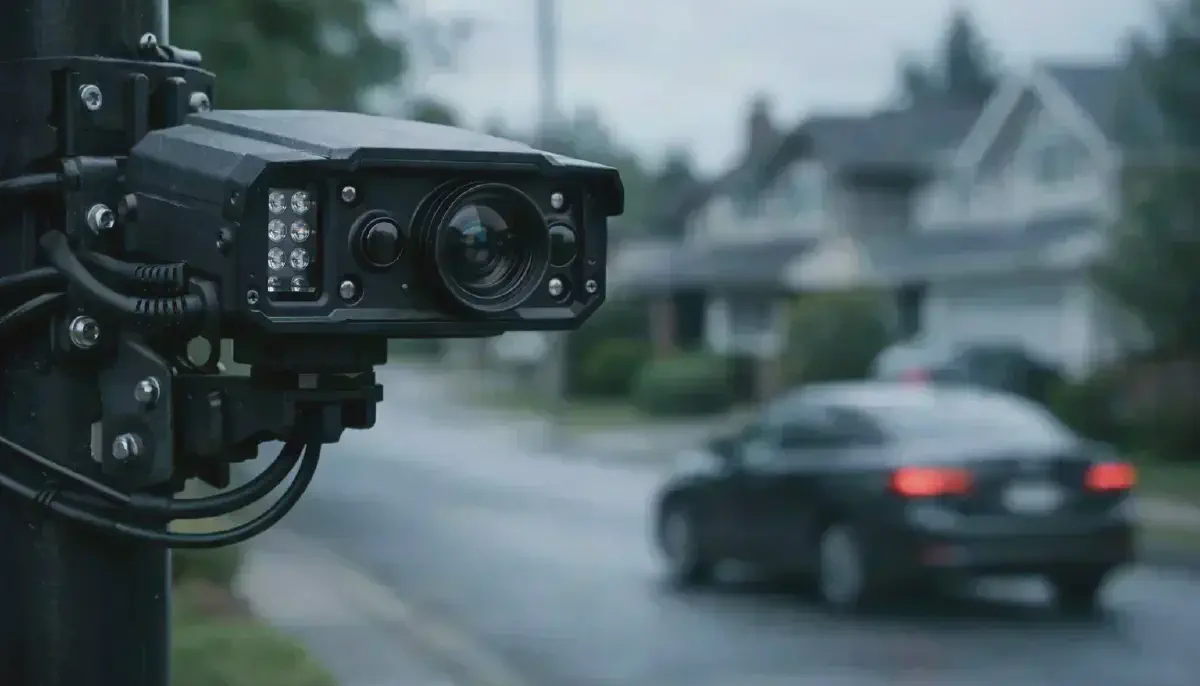
Flock Safety Cameras: The Surveillance Net We Invited In
Last month, a woman in my area posted excitedly in the neighborhood Facebook group about how their HOA’s new Flock Safety cameras had helped recover a stolen package. Seventeen thumbs up, comments full of praise, one person asking how to get them installed on their street.
Nobody asked what happened to everyone else’s data.
Three weeks later, that same woman posted again, this time confused and a little freaked out. She’d requested her own data out of curiosity and discovered the camera had logged every single one of her trips for a month. Every morning gym visit. Every afternoon school pickup. Every evening grocery run. Time-stamped. Searchable. Stored in a database accessible to law enforcement across 7,000+ agencies.
She thought she was buying safety. What she actually bought was a front-row seat to her own surveillance.
TL;DR:
- What Flock cameras actually are - Automated license plate readers creating searchable databases of everyone’s movements
- The scale of deployment - Over 100,000 cameras in 4,000+ cities, tracking without consent
- The China parallel - How this creates the technical foundation for social scoring systems
- Corporate surveillance expansion - Home Depot, Lowe’s, and the “Business Network” tracking you with zero consent
- How they’re being misused - Immigration raids, abortion surveillance, protest monitoring, racial profiling at industrial scale
- Data security nightmare - Nationwide databases, insider abuse, potential breaches
- What communities can do - Real examples of pushback and policy requirements
- The bigger choice - What kind of society we’re building, one camera contract at a time
What Flock Actually Is
Flock Safety markets itself as a “digital neighborhood watch.” They sell automated license plate reader (ALPR) cameras to police departments, HOAs, and businesses for around $2,500 per camera annually.
Here’s how it works:
Each camera photographs the license plate of every vehicle that passes by, 24/7. The system captures plate number, vehicle make, color, and other identifying features. This data gets uploaded continuously to Flock’s cloud servers with timestamps and location information.
Law enforcement can search this database. Looking for a specific plate? Type it in, get a map of everywhere that car has been spotted. Want to find all red sedans that passed through a particular intersection last Tuesday? That’s searchable too.
Over 100,000 Flock cameras are currently installed across the United States. That’s one camera for roughly every 4,000 residents. In early 2024, Flock reported deployment in over 4,000 cities. That number has only grown.
The cameras don’t require warrants to access. They don’t require probable cause. They log everyone, all the time, creating a detailed record of ordinary people’s movements.
A Wisconsin city council president put it bluntly: “There were no markings around our community that say ‘You are going to be on camera.’ Effectively, there is no way in and out of the city without being tracked. And there was no consent around that.”
One Camera For Every 4,000 Americans
Let’s pause on that scale for a second.
100,000+ cameras. 4,000+ cities.
This isn’t a pilot program. This isn’t experimental. Flock has built a functional nationwide vehicle tracking network while most people weren’t paying attention.
The cameras are everywhere:
- Neighborhood entrances in suburban subdivisions
- Major road intersections in cities
- Business district perimeters
- School zone approaches
- Highway on-ramps and off-ramps
In some communities, every entrance and exit has a Flock camera. You literally cannot drive in or out without being logged.
Privacy advocates warn that Flock is “building a dangerous nationwide mass-surveillance infrastructure.” The ACLU notes that living under constant monitoring, knowing “eventually everyone will become aware that their movements are being tracked,” is “no way to live in a democratic society.”
But here’s the thing that makes this particularly insidious: communities are paying for their own surveillance. Police departments, HOAs, and local businesses are the ones writing the checks.
Building the Infrastructure for American Social Credit
Here’s a question worth sitting with: What’s the actual difference between this and China’s surveillance systems?
The comparison isn’t hyperbolic. It’s technical.
What China Has
China’s social credit system relies on comprehensive surveillance infrastructure:
- Cameras with facial recognition tracking people’s movements
- Integration with transportation systems (metro cards, highway tolls)
- Database systems that compile movement patterns
- Algorithmic scoring based on behavior and associations
- Consequences ranging from travel restrictions to employment barriers
What America Has (Right Now)
Flock and similar systems provide:
- Cameras tracking vehicle movements (a proxy for people’s movements)
- Integration with law enforcement databases
- Searchable records of where people go and when
- The technical capacity to flag “suspicious” patterns
- Consequences already happening (immigration enforcement, protest surveillance, discriminatory stops)
The infrastructure is functionally similar. We just haven’t formally labeled it a “social credit system.”
The Missing Pieces (And Why That’s Temporary)
What separates Flock from China’s system right now:
No formal scoring algorithm - But the data exists to create one. Flock already uses AI for vehicle recognition. Extending that to behavior pattern analysis is trivial technically.
No official restrictions on movement - But the data is already being used to restrict people’s freedom (immigration enforcement, abortion surveillance). The mechanism exists, it’s just not systematized yet.
Theoretically requires law enforcement intermediary - But 7,000+ agencies have access. That’s not much of a barrier, and the access keeps expanding.
Public pushback still possible - Some communities are rejecting or limiting Flock cameras. This window won’t stay open forever.
How You Build a Social Credit System Without Calling It That
You don’t need to announce you’re building social credit infrastructure. You just need to:
Step 1: Install comprehensive surveillance (Flock cameras everywhere)
Step 2: Centralize the data (National Lookup network connecting 7,000+ agencies)
Step 3: Expand what the data is used for (already happening: immigration, abortion, protests, not just theft)
Step 4: Add more data sources (Flock is already expanding into other surveillance: audio detection, people tracking, facial recognition capabilities)
A concrete example of “adding more data sources”: Ring and Flock have started integrating Ring’s Community Requests flow with Flock’s law-enforcement platforms (FlockOS / Flock Nova), so agencies using Flock software can push requests into the Ring Neighbors ecosystem asking nearby Ring owners to share footage for an active investigation.
That is how consumer doorbell cameras get folded into the Flock surveillance apparatus in practice: even when sharing is technically voluntary, the integration makes it easy for Flock-using agencies to solicit and aggregate consumer video at scale, and it has drawn predictable privacy scrutiny.
Step 5: Apply algorithmic pattern matching (the technology is ready, it’s just a software update)
Step 6: Normalize consequences for “suspicious” patterns (already happening through discriminatory enforcement)
We’re on Step 4 heading into Step 5.
The Slippery Slope Is a Water Slide
“But we’d never allow that in America. We have constitutional protections.”
Do we, though?
Fourth Amendment protections against unreasonable search and seizure were written before mass surveillance technology existed. Courts are still figuring out whether constant tracking of vehicles in public spaces even counts as a “search.”
Meanwhile, the infrastructure gets built. The databases grow. The use cases expand.
By the time courts definitively rule on constitutionality, the surveillance network will be so entrenched that dismantling it will feel impossible.
That’s not a hypothetical. That’s the pattern we’ve seen with every previous expansion of surveillance technology. TSA security theater. NSA bulk data collection. Facial recognition proliferation. The debate about whether we should have these capabilities always comes after they’re already deployed.
What Makes American Social Credit Different (Worse?)
If we do end up with a social credit system, here’s how it might differ from China’s model:
1. Corporate ownership of the data
China’s system is state-run. Ours is privatized. Flock Safety is a for-profit company that can sell access, get acquired, pivot business models, or get breached. You can’t FOIA request a private company’s practices the same way you can government records.
2. Fragmented and opaque
China’s system is at least centralized and somewhat transparent about its existence. America’s emerging surveillance state is a patchwork of local contracts, private databases, and interconnected systems with zero public visibility into how they interact.
3. Justified through “choice”
Chinese citizens know they’re being monitored by the state. Americans are told they “chose” this by living in a neighborhood with an HOA that voted for cameras, or driving on public roads in a city with police contracts. The illusion of consent makes resistance harder.
The Most Honest Assessment?
We’re not implementing a Chinese-style social credit system. We’re building something that could end up functionally similar while maintaining plausible deniability about what it actually is.
The infrastructure is being deployed under the banner of “public safety.” The mission creep is already happening. The technical capabilities keep expanding. The oversight is minimal to nonexistent.
Whether we end up with formal social credit scoring or just continue the current trajectory of expanding surveillance with expanding consequences, the practical difference for individual freedom is minimal.
Either way, you’re being tracked. Your movements create a profile. That profile affects how you’re treated by authorities. The consequences for “wrong” associations or behaviors are real.
We just haven’t printed the scores on a card yet.
Corporate America Joins the Surveillance Party
While communities debate whether to install Flock cameras, corporate America has already made the decision for you.
Your local Home Depot and Lowe’s parking lots are likely already feeding into the Flock surveillance network. And you have zero say in it.
The Retail Surveillance Boom
In August 2025, investigative reporting revealed the extent of corporate participation in Flock’s dragnet:
Home Depot:
- Dozens of stores across Texas alone have Flock cameras
- Cameras include both license plate readers AND gunshot-detecting microphones
- Data is accessible to law enforcement without requiring a warrant from the store
Lowe’s:
- A single sheriff’s office in Texas can access cameras at 173 different Lowe’s locations across the U.S.
- That’s just ONE law enforcement agency’s access
- The actual total number of Lowe’s locations with Flock cameras is likely much higher
Both companies mention ALPR cameras in their privacy policies, buried in the fine print. Both state they share data with law enforcement “when necessary for safety or to comply with legal requirements.”
Translation: if you drive to Home Depot to buy a drill, your license plate, vehicle description, and timestamp get logged in a database accessible to thousands of law enforcement agencies.
The Flock Business Network
In June 2025, Flock launched something called the “Flock Business Network,” marketed as a “collaborative hub designed to help private sector organizations work together to solve and prevent crime.”
Let’s translate that corporate speak: Flock is building a private surveillance network where businesses pool their camera data to create even more comprehensive tracking.
Shopping malls, retail chains, corporate campuses, hospitals, and “educational institutions” are all being pitched as ideal candidates for this network.
Think about what that means in practice. You drive to:
- The shopping mall (cameras log your arrival)
- Home Depot in the same plaza (more cameras)
- The grocery store next door (more cameras)
- Your kid’s school (cameras there too)
Each stop creates a data point. Each data point is timestamped and searchable. Together, they create a detailed map of your day that gets stored in Flock’s databases and shared across the “business network.”
Zero Transparency, Zero Consent
Here’s what makes corporate surveillance particularly insidious: unlike police departments, private businesses using Flock have zero transparency requirements.
Some police departments (under public pressure) have created transparency portals where residents can see basic stats about camera usage. Not perfect, but something.
Private businesses? Nothing. You have no way to know:
- Which retail locations have Flock cameras
- How long they retain your data
- Which law enforcement agencies can access it
- What searches have been run on your vehicle
- Whether your data has been shared with ICE, or used for abortion surveillance, or flagged in a protest investigation
The Electronic Frontier Foundation put it bluntly: “What we’re learning is that two of the country’s most popular home improvement stores are contributing to the massive surveillance dragnet coordinated by Flock Safety.”
The Parking Lot Panopticon
This expansion into retail changes the surveillance calculus dramatically.
With neighborhood and police cameras, you could theoretically avoid surveillance by changing your routes, staying in your neighborhood, or being strategic about your movements.
With corporate retail surveillance, avoidance becomes nearly impossible. Unless you stop going to grocery stores, hardware stores, shopping malls, and pretty much anywhere people shop, you’re getting logged.
Every errand. Every shopping trip. Every time you take your car to run normal life errands.
The panopticon isn’t just watching the roads anymore. It’s watching the parking lots where you live your life.
Why Retailers Love This
From the retailers’ perspective, Flock cameras are sold as loss prevention. Catch shoplifters, track organized retail theft, recover stolen merchandise.
And sure, that probably happens sometimes.
But what retailers also get is a comprehensive record of everyone who visits their stores. That’s valuable data. Really valuable data.
Right now, that data is being shared with law enforcement. What happens when retailers start analyzing it themselves? When they start building customer profiles based on your vehicle movements? When they start sharing it with data brokers or insurance companies?
The infrastructure is already in place. It’s just a business model change away.
You Can’t Opt Out
When a police department installs Flock cameras, residents can at least show up to city council meetings and demand policies, transparency, or removal.
When Home Depot installs cameras in their parking lot, what’s your recourse? Don’t shop there?
Good luck avoiding every retail chain that’s joining the Flock Business Network.
This is surveillance justified through private property rights. The parking lot is theirs, so they can camera it. The fact that you have no realistic alternative to using retail parking lots is treated as irrelevant.
You’re not consenting to surveillance. You’re being told your participation in normal commercial life requires accepting surveillance.
That’s not consent. That’s coercion with extra steps.
When Package Theft Cameras Track Abortion Patients
The marketing pitch is always the same: catch car thieves, recover stolen vehicles, solve neighborhood crime. That’s not how it’s actually being used.
Immigration Dragnets
Records obtained by journalists reveal that local police routinely run Flock searches on behalf of U.S. Immigration and Customs Enforcement (ICE).
Small municipalities that adopted Flock to catch package thieves unknowingly became part of a de facto immigration surveillance network. In Virginia, outside agencies searched Flock data over 7 million times in one year, including 3,000+ searches specifically for immigration purposes.
One Virginia sheriff’s office ran more immigration-related searches than any other, admitting they were doing so at ICE’s request.
Communities that might not support immigration enforcement had their data funneled to ICE’s deportation operations without transparency or consent.
Abortion Surveillance
In 2022, a Texas police officer used Flock’s system to search nationwide for a woman who had a self-administered abortion. He entered the search reason as “had an abortion, search for female” and scanned millions of drivers’ data without a warrant.
An abortion rights group reported “overwhelming fear” among women that they’re “being watched and tracked by the state.”
An investigation later found the department had considered charging the woman and only concocted a “health concern” excuse after getting caught. Flock Safety issued a statement accepting the officer’s original excuse and complaining that “misinformation” about the incident was harming the company’s image.
Protest Monitoring
Analysis of Flock’s audit logs shows that over a recent 10-month period, more than 50 federal, state, and local agencies ran hundreds of searches connected to protest activity. Some specifically targeted known activist groups.
Attending a peaceful protest could land your car on a hotlist and subject you to tracking across state lines. That’s a powerful deterrent to free expression.
Racial Profiling At Industrial Scale
In Oak Park, Illinois, after Flock cameras were installed, 84% of drivers stopped due to Flock alerts were Black, despite Black residents being only 19% of the population.
The Electronic Frontier Foundation found police using derogatory or race-coded search terms in Flock, like “gpsy” or “Roma,” to cast a wide net for vehicles associated with Romani people.
Thanks to Flock’s nationwide reach, an officer inputting a biased search term can query thousands of cameras in one go, spanning multiple states.
As the EFF observed: “Flock’s network didn’t create racial profiling; it industrialized it.”
It turned individual prejudice into a coast-to-coast dragnet.
Who Holds Your Movement Data?
Flock retains license plate data for 30 days by default. Sounds brief until you consider the volume: one camera captures thousands of plates daily. Thirty days across a city amounts to millions of stored records.
Communities can set longer retention periods. If a plate is tagged as a “hit” or under investigation, data can be kept indefinitely.
Here’s where it gets worse: 75% of Flock’s law enforcement clients nationwide enrolled in the “National Lookup” sharing network, which links data across 7,000+ agencies.
Your local camera’s data doesn’t stay local. It becomes part of a national pool searchable by officers from anywhere, including federal entities.
Flock’s standard user agreement gives the company itself broad license to share data “for investigative purposes” with any law enforcement, even if your local department tries to opt out.
The Insider Threat
A police chief in Braselton, Georgia was arrested in 2025 for using Flock ALPR cameras to stalk and harass private citizens. He accessed Flock data from out-of-state cameras (California) while targeting an individual, exploiting the system’s interconnected reach.
This case exposed how authorized users can abuse surveillance tech for personal misconduct. What safeguards exist to prevent this? The evidence suggests very few.
The Hacking Risk
Flock stores all data in a centralized cloud. A single breach could expose a nationwide database of vehicle movements.
U.S. Senator Ron Wyden, who scrutinized Flock’s practices, warned in late 2025 that the company “cannot live up to its commitment to protect the privacy and security” of citizens.
One California activist pointed to reports that Flock data may have surfaced on the dark web, alleging the cameras are “easily hackable and the data is not encrypted.” While Flock disputed some claims, the fear is valid.
If criminals or stalkers compromise the system, they could get detailed logs of where certain vehicles have been. That’s a tool ripe for abuse.
The Transparency Vacuum
Even when police departments claim “only local police can access the data, and it’s deleted after 30 days,” reality often differs.
In San Marcos, Texas, residents and city council members were alarmed to learn their police shared Flock data with over 600 outside agencies, including departments known to forward data to ICE. No local transparency about these partnerships existed until community members demanded answers.
“We don’t even know how this technology is being used,” one council member warned.
Without robust independent oversight, promises about limited retention and access ring hollow.
Not Every Community Is Rolling Over
Awareness of these issues has led some communities to push back hard.
Verona, Wisconsin
Public outcry over lack of transparency and potential overreach led the city council to terminate its Flock camera program entirely.
San Marcos, Texas
After hours of heated testimony about privacy, racial profiling, and federal overreach, the council voted 5-2 to deny an expansion of Flock cameras despite police support.
Local lawmakers noted the absence of audits or safeguards and the ease with which external agencies could tap into the data. They concluded the promised security benefits did not outweigh civil liberties risks.
Policy Requirements That Actually Work
Some cities implementing Flock have begun requiring:
- Short retention periods strictly enforced
- Strict access controls with audit trails
- Bias auditing of searches
- Prohibition on data sharing for purposes outside core law enforcement (like immigration enforcement or First Amendment surveillance)
- Regular public reporting on camera use
These practices need to become the norm, not the exception.
The Bigger Picture: Surveillance Industrialization
This isn’t really about one company or one technology. Flock Safety is just the most visible example of a broader trend: the industrialization of surveillance.
Tools sold for “solving neighborhood crime” get repurposed to track immigrants, crack down on reproductive rights, surveil demonstrators, and disproportionately police people of color. This surveillance overreach often happens without community knowledge.
Once surveillance infrastructure is in place, it tends to be used (and misused) in ever-expanding ways, often beyond the original intent.
What starts as catching package thieves becomes monitoring abortion patients. What starts as recovering stolen cars becomes an ICE deportation tool.
The Accountability Vacuum
Flock Safety is a private company accumulating a vast trove of public movement data and selling “investigation-as-a-service.”
If something goes wrong (a data breach, system abuse, discriminatory enforcement), who is responsible?
Residents often have no clear avenue to challenge improper use short of lobbying their local government to cancel the contract. That’s cumbersome, especially if misuse isn’t discovered until after the fact.
Senator Wyden bluntly advised communities: “Local elected officials can best protect their constituents from the inevitable abuses of Flock cameras by removing Flock from their communities.”
The Choice We’re Making
Here’s what I keep coming back to: We’re building this surveillance state ourselves. With our HOA fees. With our local taxes. With our city council votes.
The trade-off being sold is safety versus privacy. But that framing is dishonest.
What we’re actually trading is:
- The ability to move through public spaces without constant monitoring
- Protection from discriminatory enforcement at scale
- Barriers against mission creep and function creep
- Some measure of freedom from state surveillance of lawful activities
In exchange for:
- Possibly recovering some stolen packages
- Maybe catching some car thieves
- The feeling of “doing something” about crime
Is that trade worth it?
For marginalized communities already subject to over-policing, the answer is clear: Flock cameras make things worse. They don’t create racial profiling, but they industrialize it. They don’t invent surveillance overreach, but they make it effortless and comprehensive.
For everyone else, the creeping normalization of constant tracking should be concerning. Privacy isn’t just about hiding wrongdoing. It’s about the freedom to go about your life without feeling like you’re in a police lineup every time you drive to the store.
What About Actual Crime?
Look, crime is real. Package theft sucks. Car theft is frustrating and expensive.
But there’s scant evidence that Flock cameras meaningfully reduce crime rates. What they definitely do is create massive databases of everyone’s movements that get used for purposes nobody voted for.
There’s a difference between solving specific crimes and surveilling entire populations just in case.
Traditional policing methods (investigations based on probable cause, warrants for surveillance, limitations on data collection) exist for good reasons. They balance public safety against civil liberties.
Flock’s model dispenses with those protections entirely. Everyone is surveilled by default. The data exists, so it gets used. Mission creep is inevitable.
What You Can Actually Do
Individual actions:
1. Know if your community has Flock cameras
Check with your local police department or city council. Many installations happen with minimal public notice.
2. Attend local meetings
City councils and HOAs make these decisions. Public pressure matters, as the San Marcos and Verona examples show.
3. Demand policy requirements
If your community insists on keeping Flock cameras, demand:
- Strict retention limits (30 days maximum, no exceptions)
- Prohibition on immigration enforcement use
- Prohibition on First Amendment activity surveillance
- Regular public audits and reporting
- Bias analysis of stops resulting from alerts
4. Support organizations fighting this
The ACLU, Electronic Frontier Foundation, and local privacy advocacy groups are challenging ALPR surveillance. They need resources and visibility.
5. Vote accordingly
Local elections matter for these decisions. Ask candidates their positions on surveillance technology.
Bottom Line
Flock Safety cameras represent a fundamental choice about what kind of communities we want to live in.
Do we want neighborhoods where everyone’s movements are automatically catalogued and searchable? Where attending a protest or visiting a clinic could land you in a database? Where a private company holds detailed records of where you’ve been?
Or do we want some measure of privacy in public spaces? Some protection against constant monitoring? Some barriers against the industrialization of surveillance?
This is happening right now, in thousands of communities, mostly without meaningful public debate or consent.
The cameras are already up. The networks are already built. The data is already being shared in ways communities never approved.
The question is whether we’re going to collectively realize what we’ve done before it’s too late to change course.
As one activist group put it: maybe it’s time to “Get The Flock Out.” Not out of paranoia, but out of a recognition that safety doesn’t have to come at the price of becoming a surveillance state.
The debate around Flock cameras is really a debate about what kind of society we’re building, one camera contract at a time.
We should all have a say in that decision before the next camera goes up on our street corner.