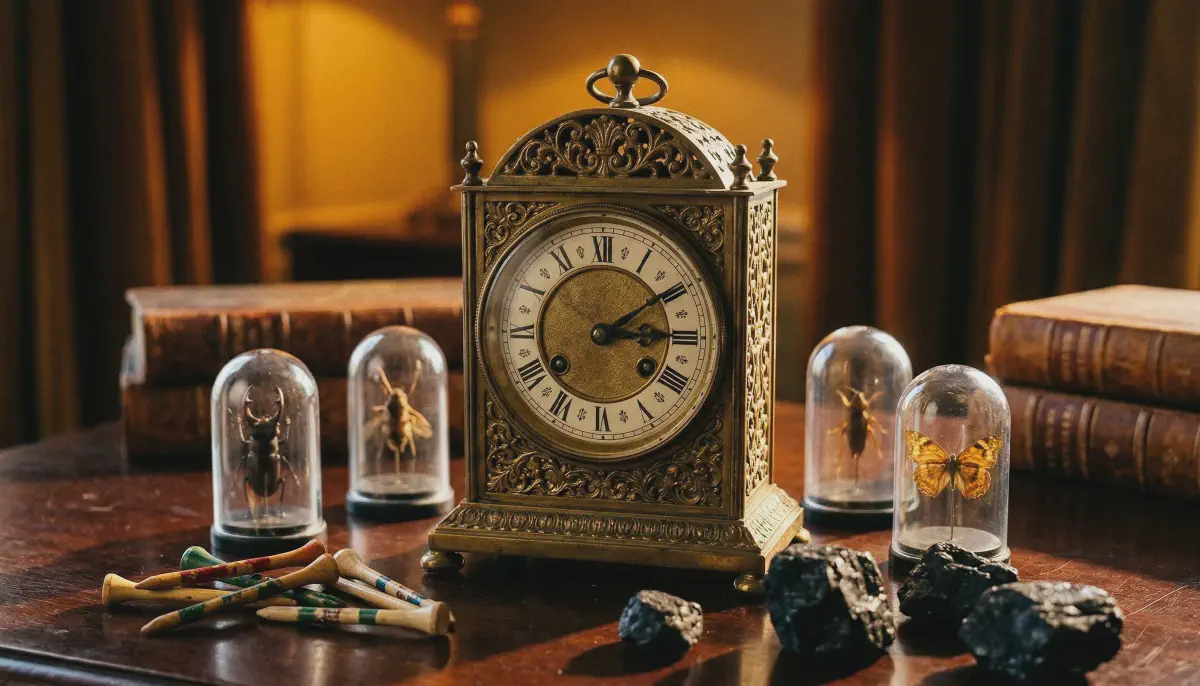
The Real History of Daylight Saving Time: A Bug Collector, a Golfer, and the Kaiser
It’s 2 AM on a Sunday morning, and roughly 300 million Americans just got pickpocketed.
Not of money or property. Of something arguably more valuable: an hour of sleep. Your phone silently lurched from 1:59 AM straight to 3:00 AM last night, and most of us won’t even register the theft until Monday morning when the alarm feels physically offensive and the coffee doesn’t quite land.
If you’re like most people, you have a vague sense that this whole Daylight Saving Time thing was invented “for the farmers” or “by Benjamin Franklin” or something about saving energy. Every single one of those beliefs is wrong. The real story involves a New Zealand postal worker obsessed with catching bugs, a British millionaire furious that sunset kept ruining his golf games, and the German Empire desperately trying to conserve coal during World War I.
It’s weirder, more petty, and more revealing about how policy actually gets made than anything you learned in school.
TL;DR:
- Benjamin Franklin didn’t invent DST - He wrote a satirical essay about firing cannons at sunrise to wake up lazy Parisians. That’s literally the whole story.
- A bug collector dreamed it up - George Hudson, a New Zealand postal worker, proposed shifting clocks TWO hours so he could hunt insects after work. The scientific community mocked him.
- A golfer turned it into a crusade - William Willett spent his personal fortune lobbying Parliament because sunset kept cutting his golf games short. He died before it passed.
- The Kaiser made it real - Imperial Germany implemented DST on April 30, 1916, purely to conserve coal for the WWI war effort. Everyone else copied them within weeks.
- Farmers HATED it from day one - Farmers have been the strongest opponents of DST since its inception. Cows don’t read clocks.
- America’s time chaos was insane - For 20 years, neighboring cities ran on different clocks. Minneapolis and St. Paul kept DIFFERENT TIMES for two weeks.
- It’s literally killing people - The spring clock change causes a 24% spike in heart attacks, 30+ annual deaths, and costs $275 million in social damages. The energy savings? A laughable 0.3%.
- Should we spring forward forever or fall back for good? - Sleep scientists overwhelmingly favor permanent standard time. The public prefers permanent DST. We’re stuck because America can’t agree on anything.
The Benjamin Franklin Myth, Debunked 🕯️
Let’s kill the most persistent myth first.
In 1784, Benjamin Franklin was living in Paris as an American envoy. He penned a satirical essay to the Journal de Paris pointing out that Parisians were sleeping through perfectly good morning sunlight and burning expensive candles at night. His tongue-in-cheek solutions included taxing window shutters, rationing candles, and (genuinely my favorite detail in all of DST history) firing cannons at sunrise to wake everyone up.
Here’s what Franklin did NOT propose: changing the clocks.
He was making fun of lazy Parisians. The entire essay was a joke. 18th-century Europe didn’t even keep precise schedules, so the concept of “shifting time” would have been meaningless. But somehow, a satirical letter from a man famous for flying kites in thunderstorms became the origin myth of Daylight Saving Time.
Franklin didn’t invent DST any more than he invented electricity. He was just a brilliant troll with a printing press.
The Bug Hunter Who Started It All 🦗
The actual, real, historically verified inventor of modern Daylight Saving Time was George Vernon Hudson. And his motivation was exactly as absurd as it sounds.
Hudson was born in London in 1867 and moved to New Zealand at age 14 with his father, already dragging along an insect collection he’d been building since childhood (he published his first entomology paper before he was a teenager). He landed a job as a postal clerk in Wellington, working shift hours that gave him afternoon free time.
Here’s the thing. Hudson’s entire problem was that the sun went down before he was done catching bugs.
That’s it. That’s the origin story of a policy that now affects 1.6 billion people worldwide. A postal worker wanted more daylight after his shift so he could go tramping around New Zealand fields with a butterfly net. In 1895, he presented a paper to the Wellington Philosophical Society proposing that clocks be shifted forward by TWO hours every spring. Not one hour. Two.
The response was a mix of genuine interest (Christchurch was into it) and ridicule. He published a follow-up paper in 1898, but the proposal went nowhere for years.
Before you write Hudson off as some eccentric crank, though, consider this: his insect collection became the largest in New Zealand and is now housed at the Museum of New Zealand Te Papa Tongarewa. He was elected a Fellow of the Royal Society of New Zealand. And in 1933, he shared the T.K. Sidey Medal with Ernest Rutherford, the father of nuclear physics.
The man who invented Daylight Saving Time was a legitimate scientific genius who just really, REALLY wanted to catch more bugs. And that’s somehow both the funniest and most human origin story a major global policy could possibly have.
The Golfer Who Made It a Crusade ⛳
If Hudson was the inventor, William Willett was the evangelist. And where Hudson was driven by entomological passion, Willett was driven by something far more relatable to anyone who’s ever been annoyed: his golf game kept getting cut short.
Willett was a wealthy British builder who lived in Chislehurst, Kent. One early summer morning in 1907, he was riding his horse through Petts Wood near his home when he noticed that all the blinds in the houses were still drawn, despite beautiful morning sunshine flooding the streets. But Willett’s real grievance was more personal. He was an avid golfer, and he was DONE with cutting his evening rounds short because the sun insisted on setting.
Think about that for a second. One of the most disruptive time policies in modern history exists partly because a rich British dude was annoyed about golf.
Willett didn’t just complain, though. Using his own considerable fortune, he published a pamphlet in 1907 called The Waste of Daylight. His proposal was actually more complex than what we use today: he wanted to advance clocks by 80 minutes total, in four incremental 20-minute steps during April, then reverse the process in September. He calculated this would save £2.5 million in lighting costs (a massive sum in 1907 money).
He recruited a Member of Parliament named Robert Pearce, who introduced the first Daylight Saving Bill to the House of Commons on February 12, 1908. Even a young Winston Churchill supported it for a time.
But Parliament couldn’t agree. Committee after committee examined the issue. Bill after bill died in the following years. Willett spent years and a personal fortune lobbying, debating, and advocating.
He died of influenza on March 4, 1915, at age 58. He never saw his idea become law.
There’s a memorial sundial in Petts Wood set permanently to Daylight Saving Time. The local pub is called The Daylight Inn. And here’s a detail that somehow makes all of this even more surreal: William Willett is the great-great-grandfather of Chris Martin, the lead singer of Coldplay. The guy who wrote “Clocks.”
The Kaiser’s Coal Problem ⚔️
Hudson proposed it. Willett championed it. But it took the bloodiest conflict the world had ever seen to actually make it happen.
By 1916, World War I had been grinding on for two years. The German Empire was burning through coal at staggering rates, needing it for weapons manufacturing, heating, and transportation. Every ton of coal that went to power street lights and household lamps was a ton that couldn’t fuel the war machine.
On April 30, 1916, the German Empire and its ally Austria-Hungary became the first nations on Earth to implement Daylight Saving Time. The German word for it was Sommerzeit (summer time), and the goal was brutally simple: shift the clocks so people used less artificial lighting in the evenings, freeing up coal for the war effort.
There was no grand vision about “giving people more leisure time.” No concern about quality of life. This was a wartime resource conservation measure, full stop.
And it worked well enough that everyone copied it. Britain followed on May 21, 1916, passing DST under the Defence of the Realm Act (the same emergency powers used to ban bonfires and restrict pub hours). The rest of Europe piled on within weeks. The United States adopted it on March 31, 1918, about a year before the war ended.
Look, I get that good ideas can emerge from terrible circumstances. Penicillin came from a contaminated petri dish. The internet came from military research. But there’s something worth sitting with in the fact that the twice-yearly ritual of clock-changing that disrupts billions of lives originated as a coal-saving measure for the Kaiser’s war machine. It wasn’t designed for your benefit. It was designed to power artillery.
The Farmer Myth Is Complete Garbage 🚜
This is where I start to get genuinely frustrated.
Ask the average American why we have Daylight Saving Time, and they’ll tell you “it’s for the farmers.” This is not just wrong. It’s the OPPOSITE of the truth. Farmers have been the single strongest lobby against DST since the day it was first proposed.
Think about it for five seconds. Farmers don’t work by the clock. They work by the sun. Morning dew determines when crops can be harvested. Dairy cows need to be milked on their biological schedule, not whatever arbitrary time Congress decided it should be. Moving the clock forward by an hour means farmers lose an hour of morning daylight exactly when they need it most.
When the U.S. adopted DST in 1918, farm-state representatives were furious. After the war ended, agricultural interests were the primary force behind repealing the federal DST law. Congress overrode President Woodrow Wilson’s veto TWICE to kill it. (Wilson, it should be noted, was an avid golfer. The golf-to-DST pipeline is disturbingly real.)
The farmer myth persists because it sounds logical if you don’t think about it. “Farmers need daylight, DST gives more daylight, therefore DST helps farmers.” But farmers already had all the daylight they needed. They got up at dawn regardless of what the clock said. DST actually screwed up their market schedules because the buyers and transporters in town were now operating on a shifted timetable.
This is a textbook example of how confident-sounding nonsense can override easily verifiable facts for over a century. It’s the kind of myth that survives because correcting it requires more effort than repeating it.
America’s Great Time Chaos 🤯
Still with me? Good. Because this next part is genuinely unhinged.
After World War II, the federal DST law expired and the country entered what can only be described as temporal anarchy.
From 1945 to 1966, there was NO federal law governing Daylight Saving Time. States, cities, and even individual towns could decide if, when, and how long to observe DST. The result was chaos that makes our current system look elegant by comparison.
By 1954, only California and Nevada had statewide DST west of the Mississippi River. According to the 1964 Official Railway Guide, 21 of the 48 contiguous states had no DST ANYWHERE. Eighteen states observed it for six months, eighteen had no formal policy but allowed individual cities to do their own thing, and twelve states ignored it entirely.
And then there were the truly unhinged situations.
In May 1965, the neighboring cities of St. Paul and Minneapolis, Minnesota, ran on DIFFERENT CLOCKS for two weeks. St. Paul switched to DST on one date while Minneapolis followed a later date set by state law. Same metropolitan area. Different times. For fourteen days.
Parts of North Dakota and Texas experimented with what amounted to “reverse” Daylight Saving Time, essentially setting their clocks BACK an hour instead of forward.
If you were a bus driver, a train conductor, or a radio broadcaster during this period, you were navigating a time zone obstacle course with no map. The transportation industry eventually had enough and lobbied hard for federal regulation, which finally came as the Uniform Time Act of 1966.
Even then, the chaos didn’t fully end. Indiana became a county-by-county patchwork of DST observance and didn’t standardize until 2006. Arizona opted out entirely (and still doesn’t observe DST). Hawaii never participated at all.
And here’s something that STILL trips people up: the Navajo Nation (which spans parts of Arizona, New Mexico, and Utah) observes DST. But the Hopi Nation, whose territory is completely surrounded by the Arizona portion of the Navajo Nation, does NOT observe DST. So you can drive through Arizona and cross time zone boundaries multiple times without ever crossing a single state line.
The Candy Industry’s Dirty Secret 🍬
Here’s where the story goes from absurd to genuinely infuriating.
In the mid-1980s, the Clorox Company and 7-Eleven provided the primary funding for something called the Daylight Saving Time Coalition, which successfully lobbied for the 1987 extension of DST. Their logic was straightforward: people buy more charcoal and Slurpees when it stays light later. More evening daylight equals more consumer spending.
But the real outrage came in 2005, when DST was extended by another four to five weeks through the Energy Policy Act. The candy industry was one of the primary lobbying forces behind this extension. Their specific goal? To push the end of DST past October 31.
The reason your clocks don’t fall back until the first Sunday in November (instead of the last Sunday in October) is significantly because candy companies wanted trick-or-treaters to have an extra hour of daylight on Halloween. They wanted to sell more candy.
Both senators from Idaho (Larry Craig and Mike Crapo) voted for the extension. Their stated reasoning? Fast-food restaurants sell more French fries during DST, and Idaho produces a lot of potatoes. Therefore, more DST equals more French fry sales equals more Idaho potato revenue.
Your sleep schedule is partially dictated by the profit margins of candy companies and potato farmers. That’s not a conspiracy theory. That’s the public legislative record.
Your Body Knows This Is Wrong 🧠
Let me break down the health data, because this is where the conversation shifts from “funny historical quirk” to “genuinely dangerous policy.”
The twice-yearly clock change isn’t just annoying. It’s measurably, statistically lethal.
A 2017 study published in the American Economic Journal: Applied Economics estimated that the spring transition into DST causes over 30 deaths annually at a social cost of approximately $275 million, primarily through increased sleep deprivation. That’s not a typo. People die from this every single year.
The data gets worse the closer you look:
- 24% increase in heart attacks in the days following the spring clock change
- Measurable spike in traffic accidents during transition days (documented across North America and the UK)
- Disrupted circadian rhythms that cascade into metabolic, cardiovascular, and psychological effects
- An LSE study found the spring transition decreases life satisfaction by roughly 1.44% and cuts leisure time by about 10 minutes per day in the following period
- Increased medical errors in the days after the change
- Measurable decreases in workplace productivity
And the supposed energy savings that justified all of this? A 2017 meta-analysis of 44 studies found that DST leads to electricity savings of… 0.3%. A Department of Energy report from 2008 found the 2007 extension saved the nation 0.03% of total annual energy.
We’re putting people in the hospital and in the ground to save a fraction of a fraction of a percent of electricity. The original coal-saving rationale made some sense in 1916, when evening lighting was a major chunk of energy consumption. Today, lighting is a tiny slice of total energy use compared to air conditioning, heating, and transportation. The cost-benefit equation is laughable.
Russia tried permanent DST in 2011 and abandoned it by 2014 because winter mornings became intolerably dark. Mexico ended the practice entirely in 2022. The EU has been debating eliminating clock changes since 2019. Globally, only about 34% of countries still do this. We’re clinging to a system that most of the world has either abandoned or is actively trying to leave.
Spring Forward Forever or Fall Back for Good? ⏰
This is where it gets messy. Because even though roughly 75% of Americans agree we should stop changing clocks twice a year, the conversation fractures the moment you ask the obvious follow-up: which time do we keep?
We’re trapped between two camps, and both have legitimate arguments. But the science points in one direction while public sentiment pulls in the other. Classic American policy dilemma.
The Case for Permanent Standard Time (Fall Back for Good) 🌅
The medical and scientific establishment is nearly unanimous on this one. Permanent standard time is endorsed by the American Academy of Sleep Medicine, the National Sleep Foundation, the American College of Chest Physicians, the National Safety Council, the World Sleep Society, the Society for Research on Biological Rhythms, and a long list of European counterparts.
Their reasoning is rooted in circadian biology. Standard time keeps solar noon closer to clock noon, which means your body’s internal clock stays better aligned with the actual sun. Morning light exposure is the single most powerful regulator of human circadian rhythms, and permanent standard time maximizes it.
A 2025 Stanford study modeled the circadian health impact of both options across the continental U.S. using CDC health data. The results were striking: switching to permanent standard time was predicted to reduce cases of obesity by 2.6 million and stroke by 300,000. Permanent DST also showed improvements over the current switching system, but to a significantly lesser degree.
The education and child safety organizations (National PTA, National Education Association, American Federation of Teachers, National School Boards Association) also back permanent standard time. Their concern is practical: darker winter mornings mean children commuting to school in the dark, which is both a safety hazard and detrimental to learning.
The environmental case also favors standard time. Research shows DST observation increases morning heating costs, evening driving, and residential air conditioning use in the evenings. And here’s a number worth remembering: poor sleep (which DST disrupts and permanent DST would worsen in winter) costs the U.S. economy approximately $411 billion annually in lost productivity, according to a Rand Europe analysis. That’s 1.23 million workdays evaporating every year.
The Case for Permanent DST (Spring Forward Forever) 🌇
The business community has backed DST since the U.S. Chamber of Commerce started lobbying for it in 1915. Retail, sports, recreation, and tourism industries all benefit from longer evening daylight. More sunlight after 5 PM means more consumer spending, more outdoor activity, and (according to the data) less crime.
And there are real safety benefits to longer evenings. A Rutgers meta-analysis found that permanent DST would eliminate approximately 171 pedestrian fatalities per year, a 13% reduction, because the most dangerous time for pedestrians is the evening commute, not the morning one. More evening light also correlates with reduced seasonal depression, which is a genuine quality-of-life consideration.
There’s also a pragmatic argument: DST is already observed for about 65% of the year (34 out of 52 weeks). It’s effectively the default. Making it permanent would mean less disruption than switching to permanent standard time, because for most of the year nothing would change.
We Already Tried This. It Failed. 🔄
Before anyone gets too enthusiastic about permanent DST, though, it’s worth remembering that the United States already ran this experiment.
In January 1974, responding to the oil crisis, President Nixon enacted year-round DST. Initial public support was 79%. The vibes were immaculate.
Then winter hit.
Sunrise in some areas didn’t happen until well after 8 AM. Children were walking to school and waiting at bus stops in pitch darkness. Within months of the law taking effect, eight schoolchildren were killed in morning traffic accidents in Florida alone. Governor Reubin Askew asked Congress to repeal the law immediately.
By March 1974, public support had cratered from 79% to 42%. Congress reversed course and ended the experiment by October. The lesson was stark: people love the idea of permanent DST because they imagine summer evenings, not January mornings.
Russia learned the same lesson decades later. They switched to permanent DST in 2011, endured three increasingly miserable dark winters, and abandoned it in 2014 for permanent standard time.
The Legislative Comedy of Errors 🏛️
So if everyone agrees we should stop switching, why can’t Congress just pick one?
In March 2022, the U.S. Senate passed the Sunshine Protection Act by unanimous consent. The bill would have made DST permanent year-round. Sounds like progress, right?
Here’s where it becomes a farce: multiple senators later admitted they didn’t realize they were voting on it. The bill passed through a procedural mechanism (unanimous consent) where it only takes one objector to block it. Senator Marco Rubio’s office had notified every other senator’s office, but many staffers “vetted the request” themselves and decided it was too minor to bring to their boss’s attention.
Senator Tom Cotton was reportedly “vehemently opposed” to the bill but was never informed the vote was happening. It passed the Senate, then quietly died in the House without a vote.
Rubio has reintroduced the bill in every Congressional session since 2018. It has been introduced eight times. It has never passed the House.
Meanwhile, more than 30 states have passed their own resolutions indicating they want permanent time of some kind. Several New England states have proposed a creative workaround: instead of asking for permanent DST (which federal law prohibits), they’d petition to move from the Eastern Time Zone to the Atlantic Time Zone (which is one hour ahead of Eastern). The practical effect would be identical to permanent DST, just without the legal headache. Washington state proposed the same trick with the Mountain Time Zone.
The Most Honest Assessment
The science overwhelmingly favors permanent standard time. The public (when polled in the abstract, imagining long summer evenings) leans toward permanent DST. The 1974 experiment and Russia’s experience both demonstrate that permanent DST is significantly less pleasant in practice than in theory.
The real consensus isn’t about which option is better. It’s that the switching itself is the worst possible choice, and we keep making it because Congress can’t agree on the alternative. A 2023 YouGov poll found that among the 62% of Americans who want to stop switching, about half prefer permanent DST, 31% prefer permanent standard time, and 19% don’t care which.
In other words: the country overwhelmingly agrees on the problem and is completely paralyzed on the solution. Which, if you’ve been paying attention to American governance for the last few decades, should surprise absolutely no one.
The Bottom Line 🔥
Let’s zoom out.
The original reasons for DST (coal conservation for a World War) are over a century obsolete. The energy savings are statistically negligible (0.3% at best, 0.03% per the DOE). The health costs are measurable and real: heart attacks, traffic fatalities, medical errors, circadian disruption. And the system has been co-opted by industries (candy companies, convenience stores, sporting goods manufacturers) that profit from extra evening daylight at everyone else’s expense.
A New Zealand postal worker wanted more time to hunt insects. A wealthy British golfer wanted to play 18 holes without losing daylight. The Kaiser needed to save coal for his war machine. And now 1.6 billion people worldwide shift their clocks twice a year because of those three circumstances, plus the lobbying budgets of 7-Eleven and the National Confectioners Association.
Questions to consider:
- If 75% of Americans want to stop switching, and the medical evidence is clear, what does it say about our legislative process that Congress can’t act?
- Should we defer to sleep scientists (who favor permanent standard time) or aggregate public preference (which leans permanent DST), knowing the public’s preference was already tested in 1974 and abandoned within months?
- How many other policies that affect your daily life trace back to one person’s hobby, one industry’s profit motive, or one war that ended a century ago?
The clocks sprang forward this weekend. You lost an hour. Somewhere around 30 people this month will lose something they can’t get back. And in Petts Wood, there’s a sundial that permanently displays a time that exists because a man who died of influenza in 1915 never got to finish his round of golf.